


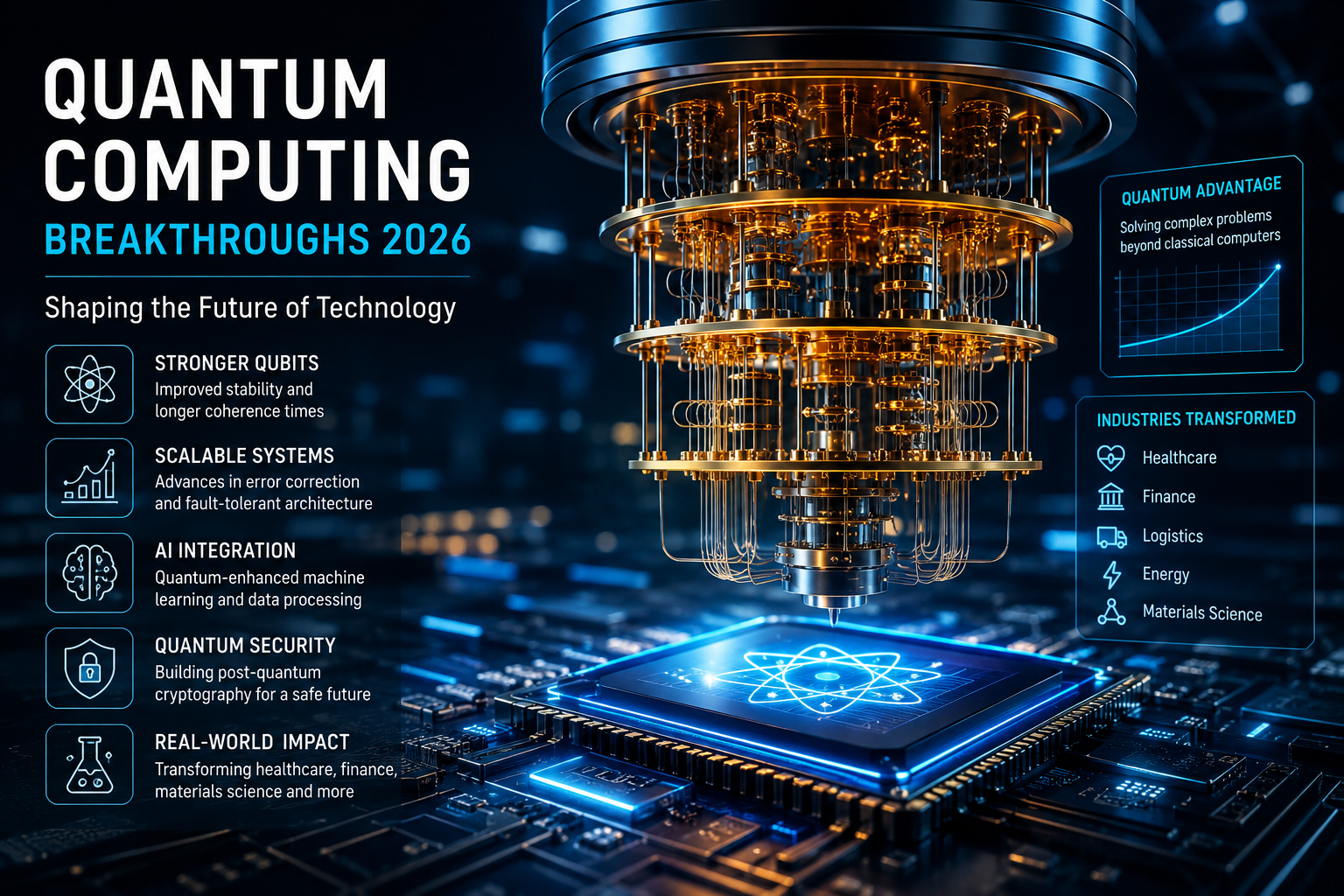
Quantum computing has long been considered one of the most revolutionary technologies of the 21st century. While traditional computers process information using bits represented as either 0 or 1, quantum computers utilize quantum bits, or qubits, which can exist in multiple states simultaneously. This unique capability enables quantum machines to solve certain problems exponentially faster than classical computers. In recent years, the pace of innovation has accelerated dramatically, and the latest breakthroughs in quantum computing 2026 are bringing the world closer to practical quantum applications than ever before.
Understanding the Quantum Computing Revolution
Quantum computing relies on the principles of quantum mechanics, including superposition, entanglement, and quantum interference. These properties allow quantum systems to perform complex calculations that would take conventional supercomputers thousands or even millions of years to complete.
Researchers, governments, and technology companies have invested billions of dollars into quantum research. The result is a wave of innovation that is reshaping industries such as healthcare, finance, cybersecurity, logistics, and materials science. The latest breakthroughs in quantum computing 2026 demonstrate how rapidly the field is evolving from theoretical research into real-world implementation.
Significant Improvements in Qubit Stability
One of the biggest challenges in quantum computing has always been qubit stability. Quantum states are extremely fragile and can easily be disrupted by environmental factors such as temperature fluctuations, electromagnetic interference, and vibration. This phenomenon, known as decoherence, has limited the practical performance of quantum computers.
Among the latest breakthroughs in quantum computing 2026, researchers have developed advanced error-correction techniques and more stable qubit architectures. New materials and innovative chip designs have significantly increased coherence times, allowing quantum computers to maintain calculations for longer periods. These improvements are making quantum systems more reliable and scalable.
Advances in Quantum Error Correction
Error correction is essential for building large-scale quantum computers. Unlike classical computers, where errors can be corrected relatively easily, quantum systems require sophisticated methods that preserve delicate quantum states.
The latest breakthroughs in quantum computing 2026 include highly efficient quantum error-correcting codes capable of detecting and correcting errors with fewer physical qubits. This advancement reduces hardware requirements and improves computational efficiency. As a result, researchers are now able to run more complex quantum algorithms with greater accuracy than ever before.
Quantum Supremacy Reaches New Milestones
Quantum supremacy refers to the point at which a quantum computer can perform a calculation beyond the practical capabilities of the most powerful classical computers. While early demonstrations proved the concept, many experts questioned their practical value.
Today, the latest breakthroughs in quantum computing 2026 have moved beyond theoretical benchmarks. Modern quantum processors are solving increasingly useful problems in optimization, simulation, and machine learning. These achievements are helping businesses and researchers explore applications that deliver measurable advantages over traditional computing methods.
Quantum Computing and Artificial Intelligence
Artificial intelligence continues to drive innovation across industries, and quantum computing is becoming an important catalyst for future AI development. Quantum-enhanced machine learning algorithms can analyze massive datasets more efficiently than classical approaches.
One of the most exciting aspects of the latest breakthroughs in quantum computing 2026 is the growing integration of quantum technologies with AI systems. Researchers are developing hybrid quantum-classical models capable of accelerating pattern recognition, data analysis, and predictive modeling. These capabilities could lead to significant improvements in healthcare diagnostics, financial forecasting, and autonomous systems.
Drug Discovery and Medical Research
The pharmaceutical industry stands to benefit enormously from quantum computing. Simulating molecular interactions accurately remains one of the most computationally demanding tasks in science. Traditional computers struggle to model complex molecular structures with sufficient precision.
Thanks to the latest breakthroughs in quantum computing 2026, researchers can now perform advanced molecular simulations that were previously impossible. These simulations help scientists understand protein folding, identify promising drug candidates, and accelerate the development of new treatments. This could dramatically reduce the time and cost associated with bringing life-saving medicines to market.
Enhanced Cybersecurity and Post-Quantum Cryptography
Quantum computing presents both opportunities and challenges for cybersecurity. While powerful quantum computers could eventually break many existing encryption methods, they are also driving the development of more secure alternatives.
The latest breakthroughs in quantum computing 2026 have accelerated research into post-quantum cryptography, which focuses on encryption systems resistant to quantum attacks. Governments and organizations worldwide are implementing quantum-safe security standards to protect sensitive information against future threats. This transition is becoming increasingly important as quantum capabilities continue to advance.
Business Adoption Accelerates
For years, quantum computing was confined primarily to research laboratories and academic institutions. Today, businesses are beginning to explore practical quantum applications across various sectors.
The latest breakthroughs in quantum computing 2026 have encouraged major corporations to invest in quantum infrastructure, software development, and workforce training. Industries such as logistics, manufacturing, energy, and finance are testing quantum algorithms to optimize operations, reduce costs, and improve decision-making processes. Early adopters are positioning themselves to gain a significant competitive advantage in the coming years.
Cloud-Based Quantum Computing Expands Access
Access to quantum hardware was once limited to a small number of specialized organizations. Cloud platforms have changed this by allowing researchers and businesses to use quantum computers remotely through the internet.
Among the latest breakthroughs in quantum computing 2026 is the expansion of cloud-based quantum services. Improved accessibility enables startups, universities, and enterprises to experiment with quantum applications without investing in expensive infrastructure. This democratization of quantum technology is fostering innovation and accelerating the development of practical solutions.
The Road Ahead for Quantum Computing
Despite remarkable progress, challenges remain. Researchers continue working to improve scalability, reduce operational costs, and develop more efficient quantum algorithms. Building fault-tolerant quantum computers capable of solving large-scale commercial problems remains a primary objective.
Nevertheless, the latest breakthroughs in quantum computing 2026 suggest that the industry is moving steadily toward this goal. Governments, technology companies, and research institutions are collaborating to overcome remaining barriers and unlock the full potential of quantum computing.
Conclusion
Quantum computing is no longer a distant scientific dream. It is rapidly emerging as a transformative technology with the potential to revolutionize countless industries. From improved qubit stability and advanced error correction to AI integration, drug discovery, and enhanced cybersecurity, the latest breakthroughs in quantum computing 2026 highlight an exciting period of innovation and progress.
As research continues and practical applications expand, quantum computing is expected to reshape the technological landscape in ways that were once unimaginable. Organizations that understand and embrace these developments today will be better prepared to capitalize on the extraordinary opportunities that quantum technology will create in the years ahead.
